
Blog
Blog

Growth
Clarity
Support
Compassion
Blog
Insights, Inspiration, and Wellness Tips for Your Journey
Welcome to our blog, where we share valuable articles, expert advice, and insightful resources to support your mental health and well-being. Whether you’re looking for tips on managing stress, understanding emotional wellness, or exploring therapeutic approaches, our blog is here to inform and inspire you. Stay connected and empowered on your journey to a healthier, more balanced life.
Growth.
Clarity.
Support. Compassion.
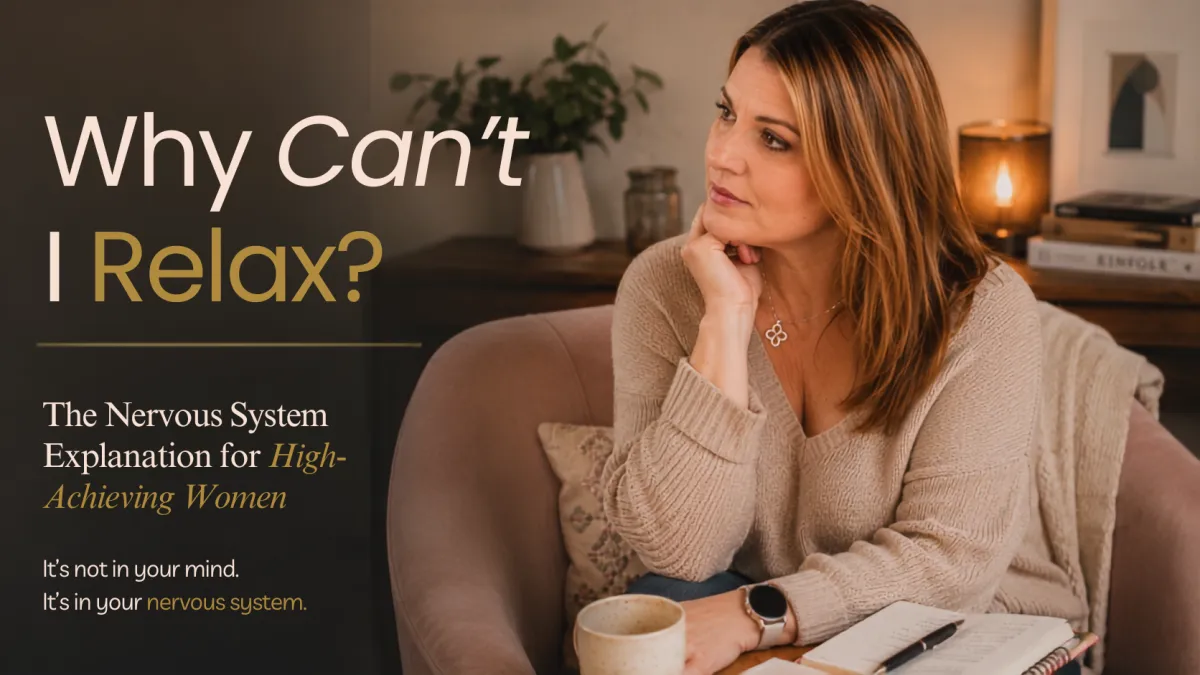
Why Can't I Relax? A Nervous System Explanation
Why Can't I Relax? The Nervous System Explanation for High-Achieving Women
You finally have an evening to yourself.
The emails are done. The washing basket can wait. Nobody is asking you for anything.
For the first time all day, there's space.
And yet instead of feeling relaxed, you feel restless.
You pick up your phone.
Put it down.
Open the fridge.
Check your emails one more time, even though you know there's nothing urgent waiting for you.
Then the thought arrives:
Why can't I relax?
It's a question I hear surprisingly often from successful women.
The woman reading this at 10:47pm, exhausted enough that her eyes sting but still mentally replaying tomorrow's to-do list, knows exactly what I mean.
So does the woman who finally arrives on holiday only to spend the first three days feeling tense, irritable, and unable to switch off.
From the outside, it looks like rest.
Inside, it feels like work.
Many women assume relaxation should happen automatically when life slows down.
I don't agree.
Relaxation is not simply the absence of tasks. It's a nervous system state.
And when a nervous system has spent years learning pressure, responsibility, hypervigilance, or survival, slowing down can feel surprisingly uncomfortable.
Sometimes even threatening.
Why Relaxation Feels So Difficult for Some Women
Most women I work with don't come to me saying they have a nervous system problem.
They say things like:
"I don't know how to switch off."
"I feel guilty when I'm not doing something."
"Even when I rest, I don't actually feel rested."
They assume they're doing relaxation incorrectly.
They're not.
The woman staring at a Netflix screen while simultaneously answering emails and mentally planning next week's meals isn't failing at rest.
Her body is responding exactly as it was trained to.
That's a very different thing.
What is nervous system dysregulation?
Nervous system dysregulation happens when the body struggles to move out of survival mode and into states of safety, rest, and recovery. Even when life becomes calmer, the nervous system may continue acting as though a threat is present.
That's why someone can be physically safe yet still feel tense, alert, anxious, or unable to relax.
This is one of the most misunderstood aspects of wellbeing.
People often treat relaxation as a skill.
In reality, relaxation is usually the result of safety.
A nervous system that doesn't feel safe won't suddenly relax because somebody tells it to.
Why Can't I Relax Even When Life Looks Fine?
Many people struggle to relax because their nervous system still feels unsafe, even when their circumstances have improved. The body often holds onto patterns of protection long after the original stress has passed.
This is where things become frustrating.
Life looks okay.
Maybe even good.
Your career is stable.
The children are older.
The relationship feels secure.
You know logically that the crisis is over.
Yet your shoulders are still up around your ears.
Sleep still feels difficult.
Your body still acts as though something bad is about to happen.
That disconnect can feel incredibly confusing.
The nervous system doesn't operate on logic alone.
It operates on repetition.
If your body spent years preparing for pressure, disappointment, criticism, conflict, or unpredictability, it may continue preparing long after those situations have changed.
Not because it's broken.
Because it's efficient.
Your Mind Wants Rest, But Your Body Doesn't Feel Safe
Think about a smoke alarm that's become overly sensitive.
The fire ended years ago.
Yet the alarm still reacts every time somebody burns a piece of toast.
The nervous system can behave in much the same way.
When you've lived through prolonged stress, emotional neglect, chronic responsibility, trauma, or years of feeling like you had to hold everything together, the body adapts.
It becomes exceptionally good at spotting possible danger.
Sometimes so good that it struggles to recognise when danger is no longer there.
That's where many nervous system dysregulation symptoms begin.
Not because you're weak.
Not because you're overreacting.
Because your body learned protection.
Why Success Doesn't Automatically Create Safety
This is something I feel strongly about.
Success and safety are not the same thing.
Too many women spend years believing that once they achieve enough, earn enough, fix enough, or accomplish enough, they will finally feel calm.
Then they arrive there.
And nothing changes internally.
The senior executive lying awake at 3am thinking about tomorrow's presentation knows this feeling.
So does the business owner checking her inbox from a hotel balcony while everybody else is enjoying breakfast.
External success can solve practical problems.
It cannot automatically teach a nervous system that it's safe to stop bracing.
What Happens When Your Nervous System Gets Stuck in Survival Mode?
When the nervous system believes danger is present, it prepares the body accordingly.
That response is automatic.
And often invisible.
Most people have heard of fight, flight, and freeze.
What receives far less attention is the survival response I see most often in high-achieving women:
Functional overdrive.
The woman who keeps going.
Keeps producing.
Keeps coping.
Keeps performing.
Even when she's running on fumes.
The High-Achieving Survival Response
The high achiever trauma response rarely looks dramatic.
In fact, it often gets rewarded.
People praise it.
Employers promote it.
Families rely on it.
Friends admire it.
From the outside, it can look like confidence, capability, and resilience.
Underneath, it often looks very different.
Perfectionism.
Over-responsibility.
An inability to rest.
A constant feeling that there's always something more to do.
The woman answering work messages from her child's football match isn't lazy.
She's often stuck inside a pattern her nervous system learned years ago.
That's why the overfunctioning trauma response can be so difficult to recognise.
It masquerades as success.
Why Rest Can Feel Uncomfortable or Even Threatening
For some women, rest doesn't feel relaxing.
It feels uncomfortable.
Almost itchy.
The moment they stop doing, their mind speeds up.
They suddenly remember tasks.
Responsibilities.
Problems.
Things they forgot.
Many women interpret this as anxiety.
Sometimes it is.
But often it's something deeper.
The nervous system has spent so long associating safety with action that stillness feels unfamiliar.
And unfamiliar doesn't always feel safe.
That's why telling women to "just relax" is often terrible advice.
A nervous system cannot be bullied into safety.
It has to experience safety.

You Deserve to Feel Safe in Your Body Again
We specialize in providing comprehensive mental health services designed to help you understand, manage, and improve your emotional and psychological well-being. Using evidence-based therapies and personalized care plans
Or book a free call to explore your options.

I provide trauma informed, compassionate, and confidential care for women navigating emotional overwhelm, anxiety, or chronic stress.
Whether you're just starting your healing journey or seeking deeper transformation, support is here with tools that truly work.
Quick links
Services
© Caroline Reed. 2026. All Rights Reserved.