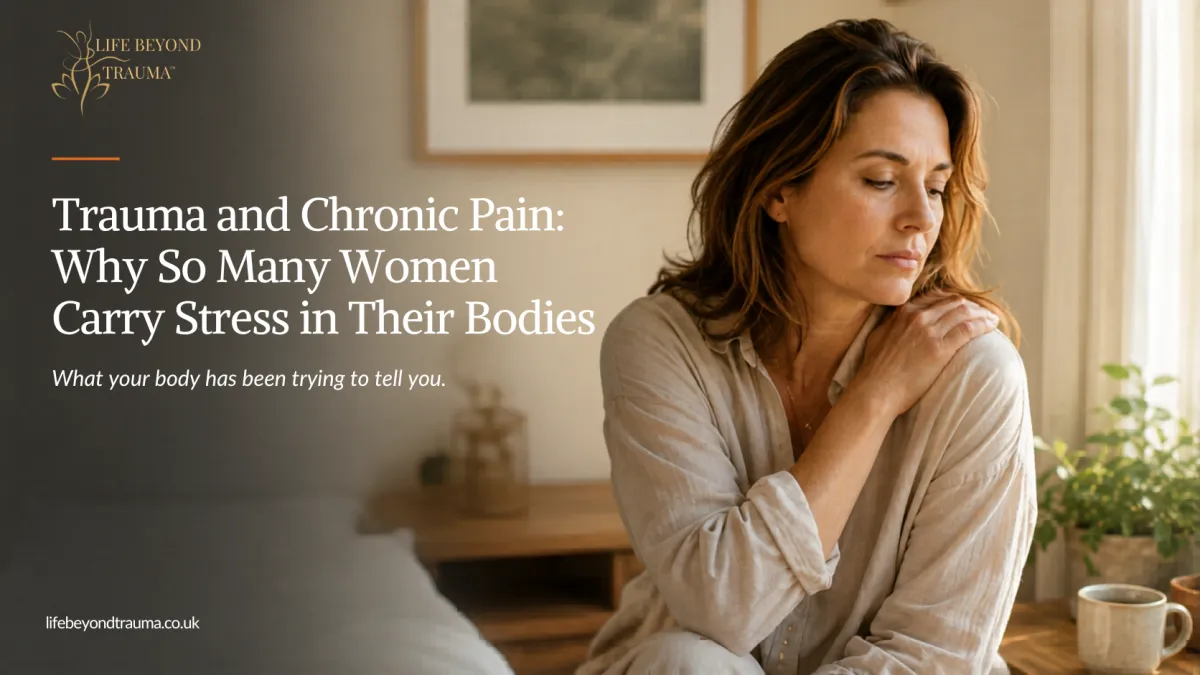
Trauma and Chronic Pain: Why So Many Women Carry Stress in Their Bodies
Your jaw hurts again.Not enough to alarm anybody.
Just enough that you notice yourself clenching it while replying to emails you do not even care about anymore.
Your shoulders feel tight before the day has properly started. Your stomach flips over tiny things. You wake up tired, already braced for the next demand before your feet even touch the floor.
And somewhere underneath all of it, a quiet thought keeps showing up:
“What if my body is trying to tell me something?”
The connection between trauma and chronic pain is far more common than most women realise.
Not because the pain is imagined.
Because the body remembers things the mind has learned to work around.
The woman reheating the same cup of tea three times because she keeps forgetting it on the kitchen counter knows this feeling. So does the woman lying awake at 1:17am with an aching neck, exhausted enough to cry but somehow still unable to fully relax.
Sometimes the body carries stress long after somebody has become good at functioning through it.
Can Trauma Really Cause Physical Pain?
Yes. Unresolved trauma can dysregulate the nervous system and keep the body in prolonged states of stress or hypervigilance. Over time, this may contribute to chronic pain, muscle tension, fatigue, headaches, digestive issues, and inflammation.
A lot of women hear this and immediately think:
“But nothing that bad happened to me.”
That is part of the problem.
People still imagine trauma as one huge catastrophic event. In reality, the nervous system also responds to years of pressure, emotional suppression, unpredictability, hyper-responsibility, or constantly feeling unsafe in small quiet ways.
Trauma Lives in the Nervous System - Not Just the Mind
When people hear the word trauma, they usually think about memory.
But trauma is physical too.
The body remembers pressure.
The body remembers fear.
The body remembers years of staying alert, staying useful, staying careful.
That is why emotional trauma stored in the body can show up physically through headaches, stomach problems, muscle pain, shallow breathing, fatigue, or chronic tension.
The nervous system does not separate emotional stress from physical stress nearly as neatly as people think it does.
To the body, survival is survival.
And honestly too many women spend years blaming themselves for symptoms that make complete nervous system sense once somebody finally explains them properly.
Why Women Often Disconnect From Their Bodies
A lot of high-achieving women learned very early that emotions needed to stay manageable.
Do not overreact.
Do not make life harder for anybody else.
Keep going.
So they became excellent at functioning while disconnected from what their body was actually feeling.
The woman smiling through a client call while her stomach twists itself into knots understands this. So does the woman who says “I’m fine” automatically before she has even paused long enough to check whether it is true.
Over time, that disconnect becomes expensive.
The body keeps trying to speak anyway.
Why Does Your Body Stay Tense Even When Life Looks Fine?
The body can stay stuck in survival patterns long after the original stress has passed. That is why some women still feel physically tense, anxious, or exhausted even when nothing appears “wrong” on the surface.
This is one of the most misunderstood parts of nervous system chronic pain.
Women often tell themselves:
“My life is stable now. I should feel okay.”
But the nervous system does not reset overnight just because circumstances changed.
It learns through repetition.
And once the body gets used to being alert all the time, tension starts feeling normal.
The Body Learns to Stay Braced
Shoulders lifted.
Jaw tight.
Breathing shallow.
Stomach clenched.
For some women, this becomes such a constant state that they only notice it when somebody points it out.
The woman gripping the steering wheel hard enough to make her wrists ache while sitting in motorway traffic knows this feeling. The woman whose smartwatch keeps warning her to breathe during meetings knows it too.
This kind of trauma related muscle tension is incredibly common.
And exhausting.
Chronic Stress Changes the Baseline
At first, stress feels temporary.
A difficult season. A hard month. Something to get through.
Then slowly, almost invisibly, the nervous system adapts around pressure.
Poor sleep becomes normal.
A racing mind becomes normal.
Body pain becomes normal.
That is why some women only realise how overwhelmed they were once their body finally forces them to stop.
Not because they were weak.
Because the body cannot stay in survival mode forever without consequences. Women are not meant to white-knuckle their way through life while calling it resilience.
Common Signs Trauma May Be Showing Up Physically
Trauma affects more than emotions. It can change breathing patterns, muscle tension, stress hormone levels, sleep quality, digestion, and pain sensitivity. Many people carry trauma physically without realising their nervous system is still in survival mode.
Sometimes the signs are loud.
Sometimes they are subtle enough to dismiss for years.
The woman keeping ibuprofen or paracetamol in every handbag “just in case” usually has a story underneath that.
Common somatic symptoms of trauma can include:
Tight shoulders or neck pain that never fully goes away
Frequent headaches or migraines
IBS or digestive discomfort during stressful periods
Waking up exhausted even after sleep
Chest tightness or shallow breathing
Muscle pain with no clear physical cause
Fatigue that rest does not fully fix
Feeling physically drained after emotional stress
Jaw clenching or teeth grinding
A constant feeling of internal tension
Not every symptom is caused by trauma.
But dismissing the nervous system completely is a mistake.
Especially when women are so often told their pain is “just stress” without anybody actually helping them understand what stress does to the body over time.
Why Do High-Achieving Women Ignore the Early Symptoms?
Productivity can hide nervous system exhaustion surprisingly well. Many women continue functioning externally while struggling internally, which makes unresolved trauma symptoms easier to miss.
Especially when everybody around them keeps praising them for coping.
Productivity Can Hide Nervous System Exhaustion
The organised woman.
The dependable woman.
The woman who never drops the ball.
From the outside, she looks completely fine.
Meanwhile, she is waking up exhausted, surviving on caffeine, clenching her jaw during meetings, and feeling emotionally flat by the time she gets home.
The body usually whispers long before it screams.
But high-achieving women are taught to override whispers.
Push through.
Keep performing.
Handle it quietly.
Until the body eventually decides it cannot keep compensating anymore.
The “Strong One” Often Pays the Highest Price
The strong one in the family.
The one everybody leans on.
The woman remembering birthdays, solving problems, calming everybody else down, and still apologising for needing space herself.
That role comes with a cost.
Emotional labour.
Perfectionism.
Hypervigilance.
Constant responsibility.
Eventually, the nervous system starts carrying all of it physically.
The woman crying quietly in the grocery store car park before driving home knows exactly how heavy that becomes.
What Happens When the Body Never Fully Feels Safe?
When the nervous system stays stuck in survival mode for long periods, the body remains tense, inflamed, exhausted, and hypersensitive even during rest.
That does not mean somebody is broken.
It means the nervous system adapted around protection.
The Link Between Hypervigilance and Pain
Symptoms of hypervigilance are not only emotional.
They are physical too.
Muscles stay guarded.
Stress hormones stay elevated.
The body keeps preparing for threat, even during ordinary moments that should feel safe.
That constant internal bracing can contribute to inflammation, fatigue, headaches, digestive issues, and chronic pain .
This is one reason why the question “Can trauma cause physical pain?”, is such an important question.
Because for many women, the answer is clearly yes.
Rest Does Not Always Mean Regulation
This part feels deeply frustrating.
You finally get time off.
You sleep more.
You cancel plans.
And somehow your body still feels exhausted.
Because rest and nervous system safety are not always the same thing.
The woman lying beside a beautiful hotel pool while mentally rehearsing tomorrow’s problems understands this feeling immediately.
Her body may be physically still.
But internally, her nervous system is still waiting for the next thing to go wrong.
Can Chronic Pain Improve When the Nervous System Heals?
Yes. Some women notice reductions in tension, fatigue, pain sensitivity, and emotional overwhelm when the nervous system begins feeling safer and more regulated.
Healing is rarely dramatic.
Usually, it is quieter than that.
The Goal Is Safety, Not Perfection
This matters.
A lot.
Women struggling with chronic pain often turn healing into another performance.
Another routine.
Another thing to optimise.
But nervous system healing usually begins with safety, not pressure.
Softer breathing.
Less bracing.
Moments where the body no longer feels like it has to stay on guard every second of the day.
That is one reason somatic therapy for chronic pain can feel so different from approaches focused only on symptom management.
The body is finally included in the conversation.
Small Shifts Matter More Than Forced Healing
Healing often begins quietly.
One full breath.
One night of slightly deeper sleep.
One conversation where your shoulders do not stay tense the entire time.
These moments seem small.
They are not.
They are signs the nervous system is beginning to trust safety again.
And that changes more than most women realise.
Your Body Is Not Working Against You
When women live with chronic pain for long enough, shame often appears alongside it.
Why can’t I just cope better?
Why am I always so exhausted?
Why does my body keep reacting like this?
But the body is not weak for responding to stress.
It is human.
Very often, what people call “the body holding trauma” is actually a nervous system trying to protect somebody for far too long.
Your symptoms are not proof that you are failing.
They are proof that your body has been carrying more than you realised.
In short:
Trauma and chronic pain are deeply connected through the nervous system.
When the body stays stuck in stress or survival mode for long periods, emotional overwhelm can start showing up physically through tension, fatigue, headaches, digestive issues, and chronic pain.
The pain is real. And for many women, healing begins when the nervous system finally experiences enough safety to stop bracing all the time.
If your body has been carrying stress for longer than you realised you are not imagining it. Explore how the Life Beyond Trauma Method helps women gently reconnect with safety, regulation, and lasting relief.
